Do Coaches Need Coaches?

While years of study refined my understanding of ideal tennis technique, even perfect knowledge does not guarantee perfect execution.
I’ve had clients ask me if being a coach means that I can simply coach myself through any problem.
I assure them: my eyes stay on the inside of my head, not the outside. I’ve been told you earn an extra set when you become a parent.
Since stepping back into the shoes of a player, I’ve fully come to terms that when I don’t have the right help, I lose my marbles. Every coach has offers something special if you give them the chance—especially when engaging with something you’re not thrilled to work on. I’ve felt just how much exceptional instruction can revolutionize my game, but I haven’t found the right person on this new adventure. Spain has a long, decorated history of legendary players, instructors and academies to explore, so I’m waiting to see what tennis legend I’ll casually run into at a cafe. Maybe I'll learn a banana forehand, de verdad.
In any case, I’ve been lucky enough to train internationally through the years, and it’s given me insight into the complexity of the training process. For starters, coaches reveal how much a student overlooks. With a brief remark, they keep players fixated on an objective, and prevent mistakes or distractions from disrupting the rhythm of the exercise.
More than that, the best coaches elevate practice to something more than a space to drill strokes: they ensure players apply their skills thoughtfully during exercises. It’s common to get lost scrutinizing strokes and dispense with strategy, so beyond mastering technique, a player’s ability to understand the dynamics of the court is a big part of what separates good from great. Good coaches do far more than run drills for an hour a week. They work with players to develop the tools and structure to make each week more precise and targeted.
One of the greatest challenges coaches have is building the trust that help people make high-order decisions on what to do with their lives. Children, in particular, often learn through examples and situations more effectively than through words or lectures. Working towards a goal that requires hundreds or thousands of hours is an abstract idea to children. An expert can show how to hone in on a skill, and generate the momentum necessary to really motivate students into giving consistent effort.
Politics has shown us that repeated, vague promises of results are enough desensitize even adults to the meaning of words. A well-functioning academy feels like home to me, because it’s really an ecosystem of social credibility. It’s a place where people care.
Coaches take the vast scope of improving a skill, filter it into something manageable, and set the stage for the student to conquer those obstacles as quickly and as efficiently as possible. By modifying the difficulty of a task, a coach seeks to accelerate progress through an activity, not arbitrarily handicap the student.
While it’s no mystery that tennis is a challenging sport, the fact that Jannik Sinner, the redheaded Italian superstar himself, hired not just one—but two co-head coaches, can make a person wonder: how much help could he possibly need, and how much better could he possibly get?
However, at the professional level, another way the coaching relationship can be understood is as “many minds, one body”. While self-reflection is critical, the more you’re pushed, the harder it is to simultaneously collect data. With a coach or other performance mentor, a team leverages the brain power of multiple individuals at the same time, giving the player a superhuman allocation of mental bandwidth.
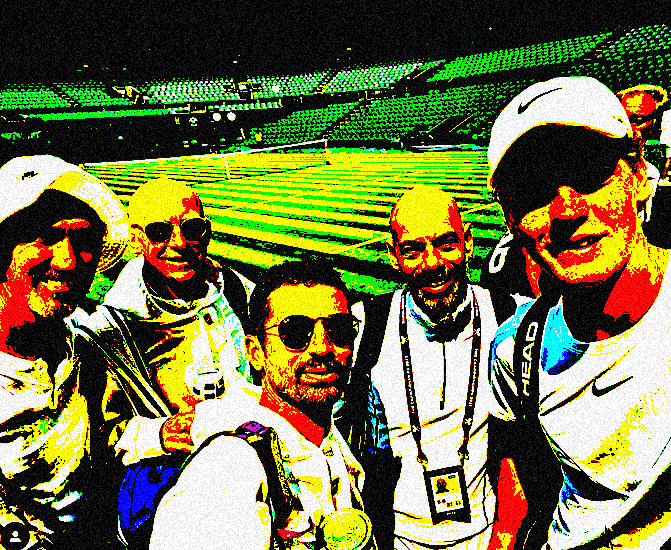
This fragment of Sinner’s team (left to right: Cahill – coach, Ferrara – trainer, Vagnozzi – coach, Cipolla – osteopath) has been with him since 2022, before his first Masters 1000 title. Since then, he has captured ten Masters and five grand slams (updated August 2026).
The more intense the rally, the quicker losing focus breaks rhythm. I learned that mindfulness at this level is an ordeal, and having someone there to keep that muscle constantly engaged makes a big difference. A former coach of mine wisely asserted that if I could not clearly recall the path of the ball in my memory, that indicated a compromise in my focus. The ball would then start “teleporting” as if I were watching a slideshow, and suddenly tennis felt much spookier than I preferred for eleven months out of the year.
Instead of doing everything at once, players focus on remaining one-hundred percent present in the moment, and coaches can provide more information about each hitting sequence, at a higher resolution. Good leadership also knows exactly how to filter and deliver the volume of information, by giving players precise instructions they can manage, and by determining exactly when it’s appropriate to break away from the exercise to talk. While athletes are busy managing the physical demands, the team plans the next moves.
Formula 1 is an extreme example of a high-functioning team infrastructure, with up to 1,200 members contributing to only two drivers and two cars. On race day, F1 teams can bring up to 60 members, a staggering figure compared to tennis, where eight is considered a large team. If the driver was the sole team member, they would be forced to diversify in their skillset, to the massive detriment of their driving abilities. In business, the larger and more complex the enterprise, the more specialized the individual members become. But in start-up culture, even the CEO is sometimes the coffee boy.
Although it starts out with improving technique, time and time again, coaches in sports achieve the status of family members through their work as counselors, mentors, cheerleaders and everything in between. When I look for a coach, I’m looking for someone who I know I can count on in every aspect of life.
While even the top players still have coaches, as tennis players, we’re alone on the court. While it’s great to have people in your corner, my belief is that the objective of a coach should be to push players to be independent—in a way, to approach obsolescence, in the same way as a parent. Whether you have ten thousand people cheering for you or empty stands, the most important thing a coach can help you find is the conviction that whatever comes your way, you’re ready.
Far beyond hitting balls, my coaches trained me in the art of approaching conflict. Being successful means embracing your role as a problem-solver: every match is a different challenge, on a different day, in a different set of conditions. If training makes you focus, makes you innovate and makes you suffer more than competition does, then few things will surprise you.
All content created without the use of generative AI.