The Art of Confidence and Mastering Your Weaknesses

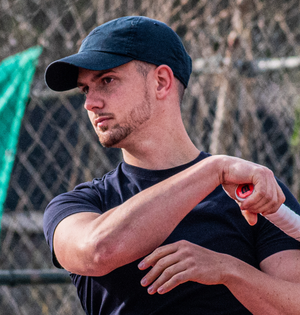
While similar in age, stature and technical mastery, its Daniil Medvedev’s legendary mental resilience that separates the former world no. 1 and Grand Slam champion from Alexander Zverev’s three failed attempts at a Major title. As of March 2026, Medvedev leads their rivalry 14-8, with Medvedev winning 13 of their last 16 meetings (Image edited by Reinhart Igna).
What distinguishes performance in practice from performance in matches? Matches impose a level of scrutiny on players that can cause even well-developed skills to break down. I often return to these six levels of competence—a framework I use to help my players understand how skills truly develop:
Level 1: the player can demonstrate a skill in a controlled ball-feeding setting, often referred to as a “dead-ball” environment.
Level 2: the player is able to demonstrate the skill in an active rally, or a “live ball” environment.
Level 3: the player can execute the skill in a low-stakes practice environment, such as a friendly point-play setting with teammates.
Level 4: the player can demonstrate the skill in a high-stakes practice environment, such as a try-out or intense evaluation.
Level 5: the player can execute the skill in a competition environment.
Mastery: a player who has achieved complete mastery can execute the skill proficiently in a high-pressure competition context, such as facing a set point.
The next time you feel discouraged, ask whether you’ve truly given yourself the opportunity to master your techniques within each environment. By forcing a competition performance too quickly, you can end up crippling your progress and your confidence.
Confidence comes from aligning expectations with real-world results. Katia and her coach spent all week hitting backhands down-the-line from the basket, and she felt solid going into her match. It was always a shot that she struggled with, but during her last lesson, she made five of them in a row. In the second set of her weekend match, she found herself down break point.
Her opponent followed in a cross-court backhand approach, leaving a wide open window down-the-line. Katia saw herself in that perfect moment, right into the situation she practiced so many times.
Except it wasn’t the same situation—and she had never practiced it.
She swung far too late. The ball flew off her strings and soared wide of the doubles alley. She was absolutely crushed. What happened? She thought: “I did all this work and I spent all this money, and I'm still not able to pull it off?”
While she prepared to hit that shot, she didn’t prepare for that environment. Her confidence slipped, the opponent took control and the match spiraled.
There wasn’t any fundamental problem with her abilities, but rather with her expectations. She felt great about her backhand in a low-pressure, low-variation setting with a hand-fed ball. She gave the skill the opportunity to flourish in this environment, and her confidence went up as a result.
However, just because Joshua gets an A on her Geometry exam doesn’t mean he’s ready to take Calculus. In fact, it’ll be practically impossible to understand, and he’ll feel much worse about himself in the process. An otherwise diligent student might start to look for short-cuts in their desperation, just to be able to pass exams. After all this, he might not even feel comfortable returning to Geometry, and he may be forced to unlearn habits he used simply to get by. Sports are as much a mental endeavor as a physical one; the pressures of repeated matches can produce techniques through the instinct to survive, rather than by coordinated practice.
In my youth, I competed on my high school’s varsity tennis team. Our school had maintained a years-long winning streak in our local division, in huge part due to the cyclical nature of the recruiting process. The school had some of the most competitive academics and athletics programs in all of California, so hundreds of ambitious student-athletes flocked to the same school, creating a grotesque imbalance within the division. While I was able to squeeze into the varsity team as a freshman, I was light-years away from the starting squad. As was customary, the other benchwarmers and I were sent out against especially weak teams for our fifteen minutes of fame. Although I was close to the bottom of the roster, I had trained in high-performance academies for years, so I was far more experienced than players who only played recreationally for their school team.
As a result, it initially appeared to me that high-school success was more for bragging rights than for personal development. However, I realized how unique the opportunity was to perform in front of my schoolmates: there was certainly more pressure than in practice, but far less than in a typical sanctioned tournament. I had discovered a new, specialty practice environment to experiment with skills and strategies that felt too risky to even attempt during tournaments, but were too comfortable to challenge me during the safety of practice. It was at this time that I started to develop my notions of iterating skills through these levels.
In some matches, I approached the net on more than half of all points, committing fully to serve-and-volley—first and second serves alike. I treated each match as a testing laboratory rather than just for domination, layering in two or even three (hopelessly unsuccessful ones, sincerest apologies to my Alcaraz fans) drop-shots per game and experimenting with a wide range of approach shot styles. Over time, these matches gave me the opportunity to feel comfortable relying on otherwise underdeveloped skills, especially under pressure.
Though I seldom faced opponents of equal skill, I grew to recognize how essential these matches were to my development. At times, my insistence on playing so creatively narrowed scorelines more than the team coach would have preferred. On the other hand, my personal coach encouraged me to try as many strategies as I felt ambitious enough to attempt. When I work with other players, I am keen to recognize how years of reservation and the absence of a sufficiently encouraging support system can stifle development and produce overly conservative, predictable play-styles.
Now, if you’re approaching a potential match while working on a skill, you have two options: If you feel as if the stakes are too high to play comfortably with your current skill-set, you should honorably, unashamedly withdraw from the match, and instead choose an environment that better suits your present developmental needs.
However, if you decide to play, you should do your best to take the pressure off of yourself. If the result doesn't go your way, it should be no surprise that you’re not fully prepared for the situation, and progress should take precedent over results. I was gladly willing to sacrifice a few high-school matches, especially considering I was developing new skills I would use to threaten high-level players who would have otherwise been untouchable to a standard player.
In Katia’s scenario, if she wasn’t so tight from feeling like she had to make that backhand, the result might have turned out differently.
I've worked with dozens of players who "flip-flop" between unpredictable, uncontrolled practice environments, and players (and oftentimes parents) struggle to make sense of all the different data points. In reality, while a player might feel dramatic deviations in their performance over a two-weeks snapshot, they’re fundamentally the same player.
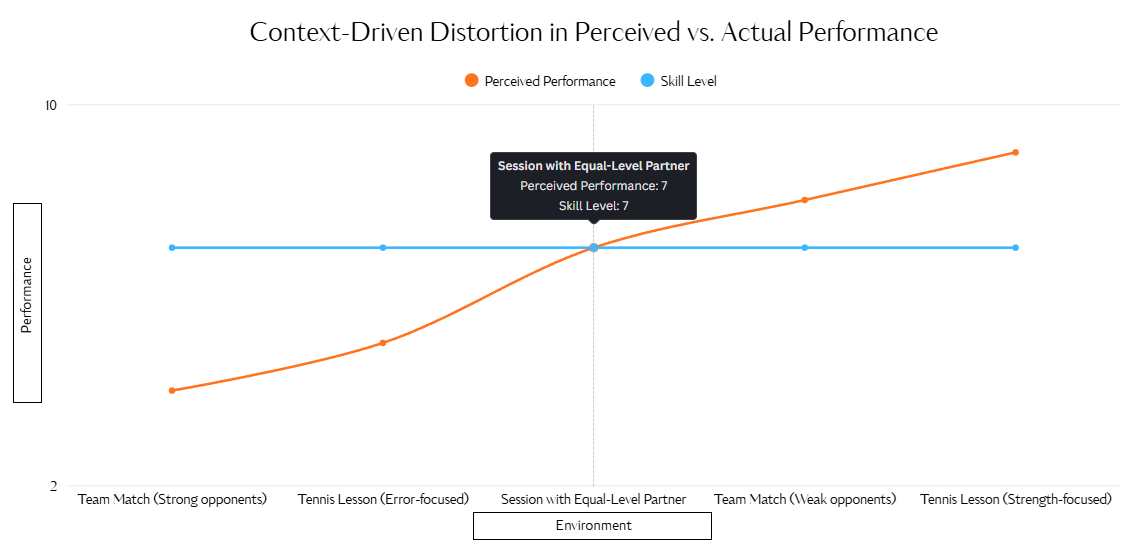
“The majority of players derive notions of performance from results, not from tangible performance metrics.”
Experienced players are able to view the multitude of shots that comprise a match in a larger macro-analysis. They’re also able to account for many more of the variables contributing to a given performance, such as the quality of the warm-up, variations in court surfaces, ball quality, and simple physiological deviations day-to-day ). It’s miraculous how little sleep a player needs to lose the night before before performance declines, especially as the match clock passes the one-hour mark (much more about these subjects in my next post).
A good or bad result doesn’t mask a good or bad attempt. A player, oftentimes with the help of a coach, must effectively apply a “grading curve” to the results to account for extraneous factors. The mental resilience and technical competence required to make 70% of your 1st serves against Roger Federer doesn’t compare to performing the same feat against your local country club captain.
Remember to take the environment into consideration, not simply the execution. It’s not about making excuses, it’s about being fair to yourself, and giving credit where credit is due.
Katia’s situation goes from: “I failed to execute a skill I should have been able to. There must be something else wrong with me.” to “Even though I only had a 30% success rate, I know that I need to give myself a chance to practice before I’ll be able to execute reliably. Although I wasn’t able to achieve my goal, I got an opportunity to practice it in a new, challenging situation.” Each and every one of those 30% she made are repetitions worth their weight in gold.
Before going into competition, a player should feel armed with confidence. There is simply no substitute for good-quality preparation, targeted specifically to your needs and your training style. Oftentimes, the biggest barrier to improvement is finding others who want practice to be maximally productive, rather than maximally convenient.
Although the jump from practice to match will always be daunting, it’s an elephant made smaller by incremental, bite-sized exposure to the proper environments. If there’s anything we can learn from the professionals, it’s that disappointment feeds progress, and loss only sweetens the fruit of success.